
What's Happening
Stay Connected
Receive the latest news, grant offerings, and community events.
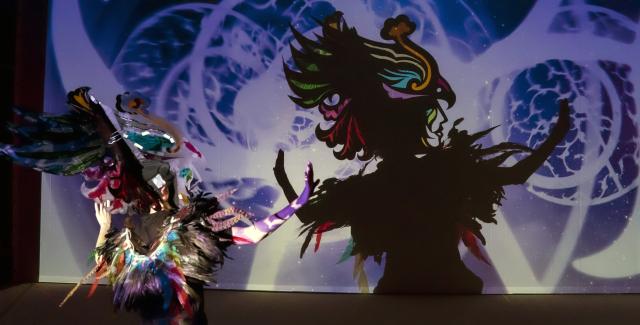
National Theater Project-supported KINGORAMA's Song of the North | courtesy of the artists
Puppetry, one of the earliest global forms of communication, is also one of the first disciplines championed by NEFA. Egypt, Greece, India, and Indonesia have records of puppetry from before the common era. The Teotihuacan culture made figurines with moveable arms and legs as early as 100 to 150 AD. It is hypothesized that these figurines, or “puppets,” were tools for understanding death and, in some community gatherings, illustrating how life comes to be. Today, puppeteers and their puppets continue to help people navigate their understanding of our existence in rituals we call public performances. Through movement and sometimes voice, actors bring puppets to life for audiences of all demographics.
One of NEFA’s earliest records, our 1980/81 annual report opened with a quote from the Northeast Regional Festival of Puppeteers of America in Lyndonville, VT:
This act of kindness speaks to both the popularity of the form and the generous spirit of those who practice it.
Puppetry is a mode of storytelling particularly beloved in the region (there are nearly 300 profiles on CreativeGround related to the art of puppetry). Bread and Puppet Theater in Glover, VT; Double Edge Theater, in Ashfield, MA; Sandglass Theater in Putney, VT; Frogtown Mountain, in Bar Harbor, ME; Puppetkabob in South Hero, VT; and more, have toured the region with support from the New England States Touring (NEST) grant program to venues like Mayo Street Arts in Portland, ME; Ko Festival of Performance in Amherst, MA; the Ballard Institute and Museum of Puppetry at the University of Connecticut (UConn) in Mansfield, Connecticut; and more. UConn’s Puppet Arts Program has more puppetry degrees than any other university in the country (CT Insider, 2023).
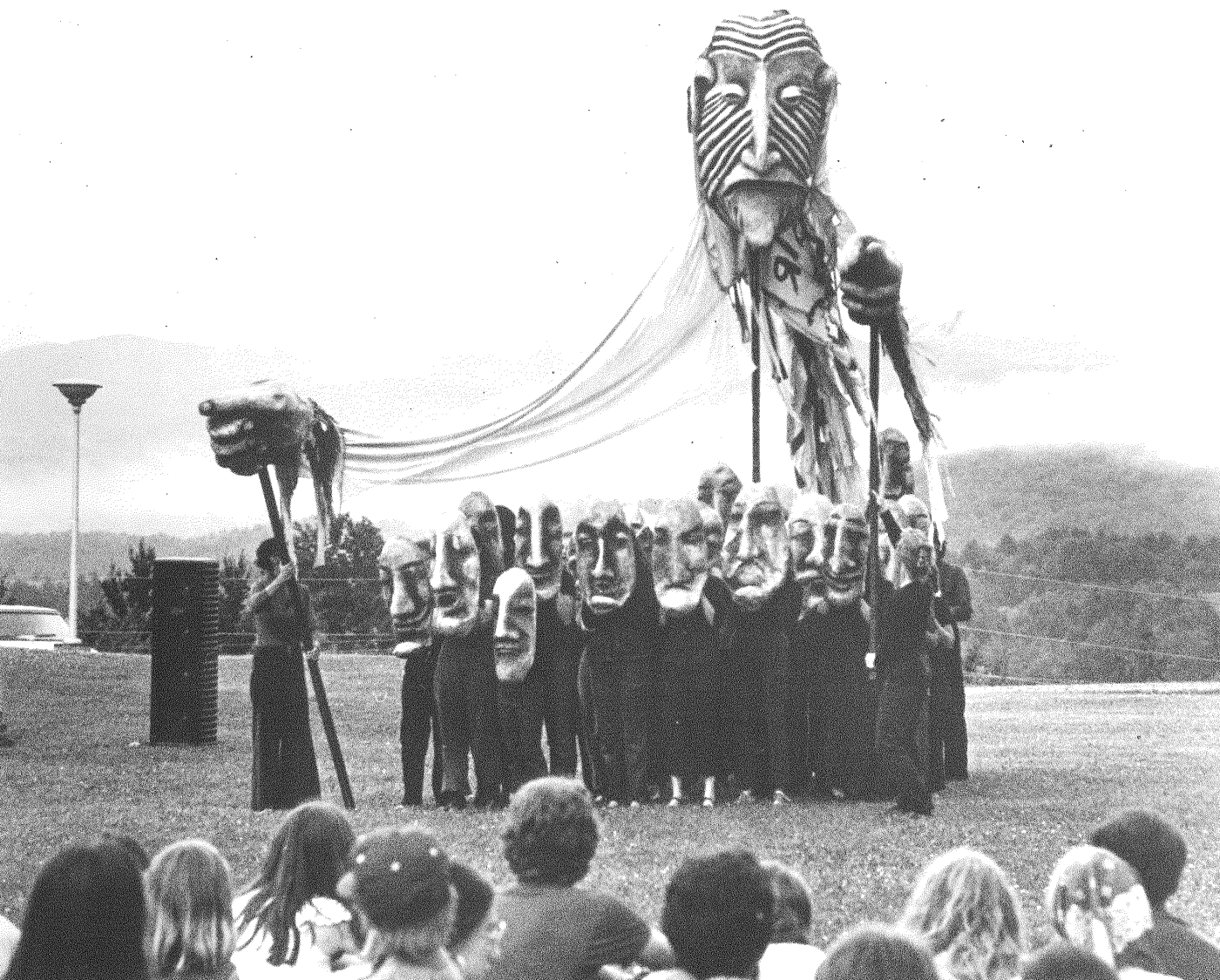
With New England’s beautiful landscape and proximity to New York City, artists doing large scale work have long been drawn to our region. Bread and Puppet Theater who brought their “lived philosophy of art and activism” from New York to Vermont in 1970 before being among the first on NEFA’s Theater, Mime, and Puppets roster in the 80s. (NEFA has since moved away from a traditional “roster;” artists can sign up to be eligible for NEST support by maintaining a profile on CreativeGround.) On this roster in the 1980s, Bread and Puppet brought their outdoor productions to communities across New England; however, this wasn’t their founding leader Peter Schumann’s first tour of the region.
German sculptor, dancer, and baker Schumann “converted his father-in-law’s small trailer into a mobile puppet stage and [hauled] it with a beat-up station wagon, [starting] an improvised solo tour across New England, putting on impromptu performances in random towns and cities along the way” (from About Bread and Puppet’s 60 Year History).
This 1981 Theater, Mime, and Puppets roster was a cache of artistic innovation, including Celebration Mime (now Celebration Barn) in South Paris, ME, founded by world-renowned mime artist Tony Montanaro who designed and hosted the CBS-TV children’s show Pretendo, which is now an international school for actors of all disciplines; Pell Award for Excellence in the Arts recipient Dan Butterworth and His Marionettes who constructed a puppet theater around an adult tricycle in Pascoag, RI; Pontine Movement Theatre’s unique synthesis of mime, puppetry, literature, and local history in Portsmouth, NH; and more.
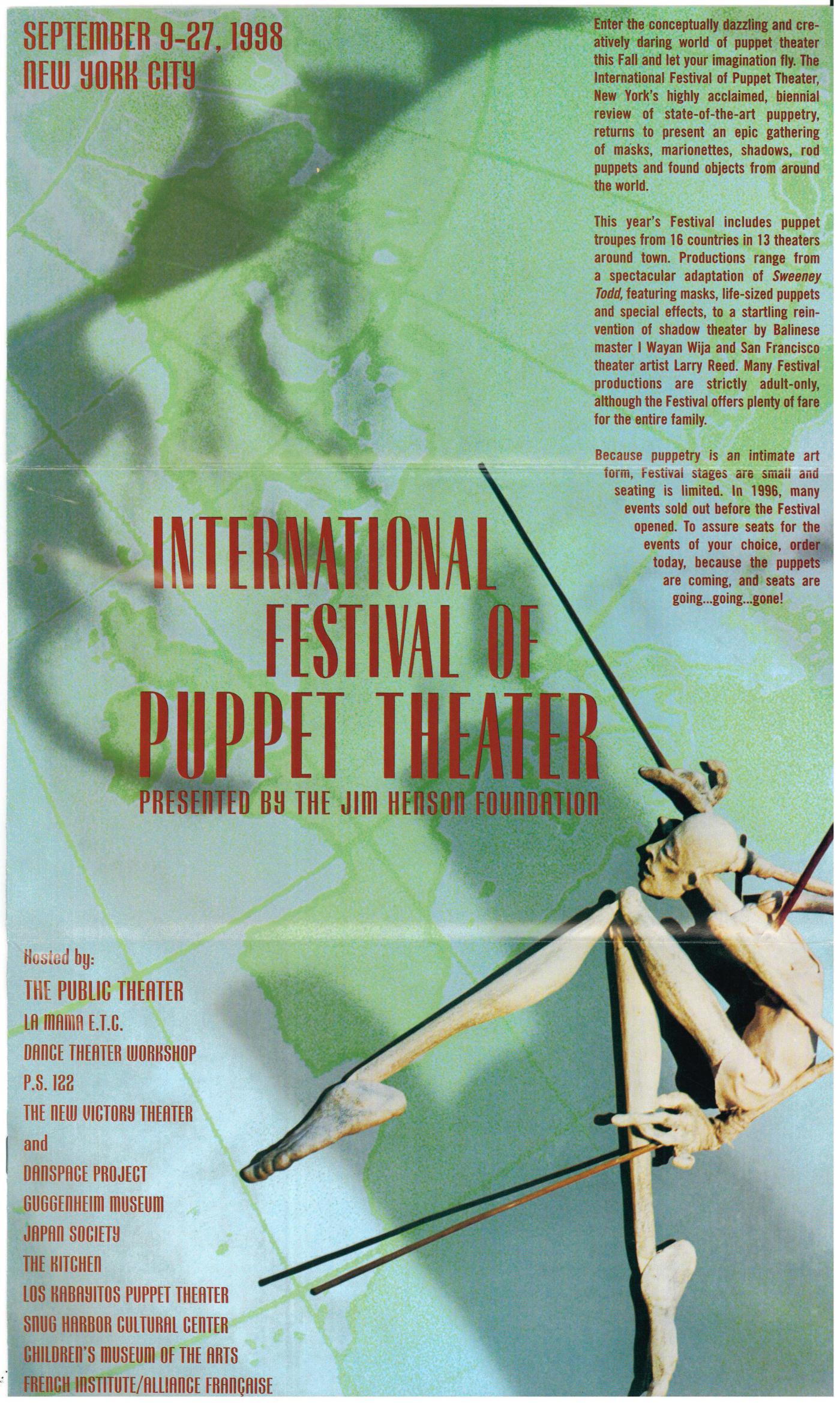
With the mainstream success of Star Wars and Jim Henson’s media projects (Sesame Street, The Muppet Show, Fraggle Rock, The Dark Crystal, Labyrinth) and the rejuvenation of the medium in the region because of touring artists, puppetry experienced a renaissance in the 1970s-90s. In 1998, NEFA partnered with Lisa Booth Management (LBMI) to bring the Jim Henson Foundation’s touring International Festival of Puppet Theater to New England. “More imaginative than Broadway and greater in its impact than the movies,” said the New York Times. Recently, two of the ensembles featured in the festival, Ping Chong and Company and Sandglass Theater, received National Theater Project (NTP) Creation and Touring support from NEFA in 2017 and 2019, respectively.
Founded in 1982, Sandglass Theatre has received numerous awards from NEFA as creatives to tour their puppetry work and as presenters to share national and international puppeteers with their local community in Putney, VT. In her piece, “Far Out on a Dirt Road: An Invitation from the Rural Arts Sector,” second generation co-artistic director, Shoshana Bass, who picks up the torch carried by her father, Eric Bass, founding director, writes:
"We provide a unique opportunity for artists to reach audiences not of their choir. In cities, audiences can choose from many cultural/arts events and will inevitably pick the event that speaks to them, their culture, their identity, and their politics. Here we have little to choose from, and when there is an event, the community comes out for a cultural experience. It is a real opportunity for dialogue and change. […] And one of the strongest ways for us to uplift voices that remain unheard and underinvested in [Putney] is to bring in outside artists to the community to strengthen representation within the community. […] We are able to experience how the act of listening to a story has led to real, tangible transformation and to people asking certain important questions for the first time, recognizing the diversity that does exist here, and sometimes even being moved into action."
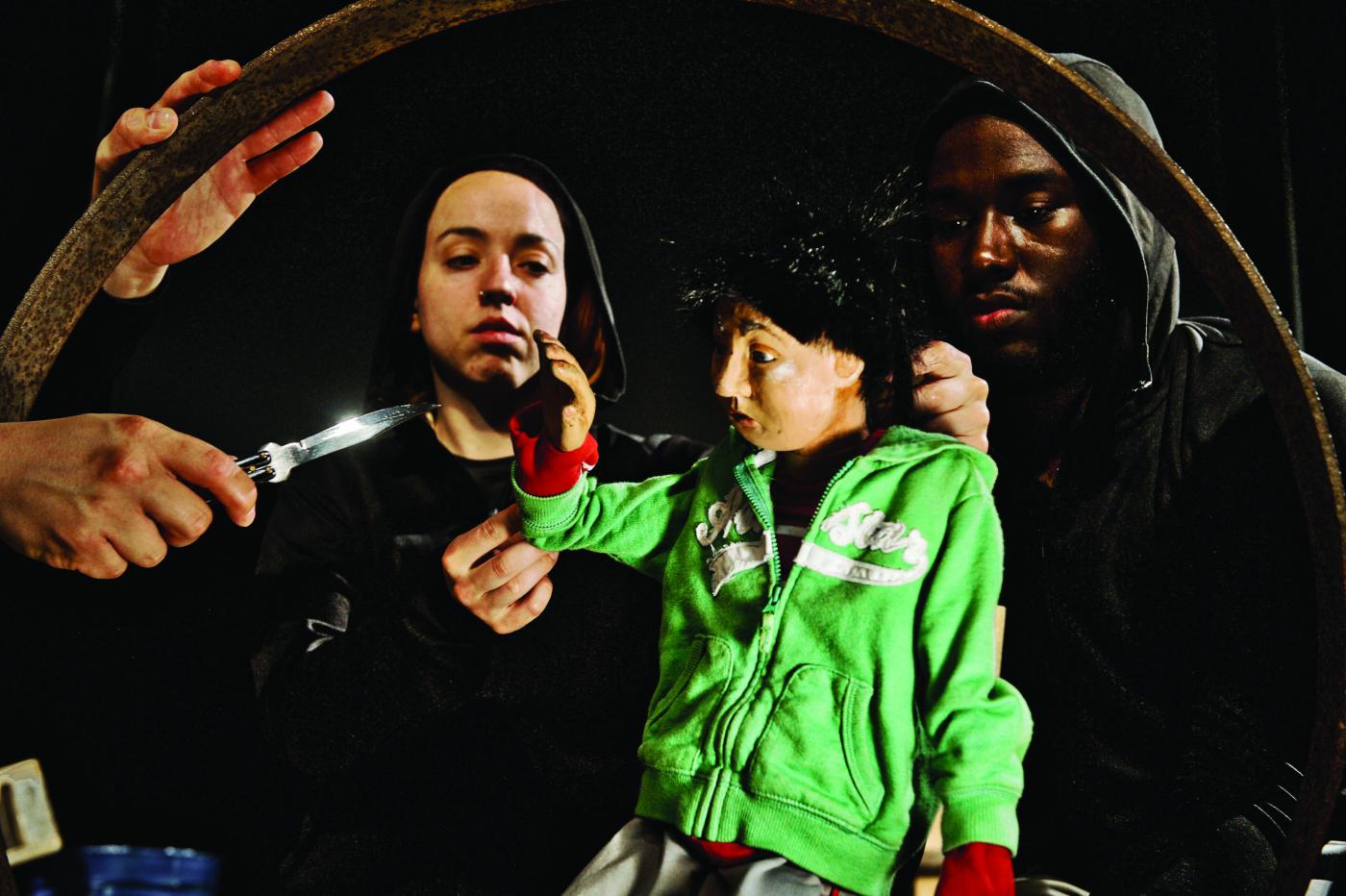
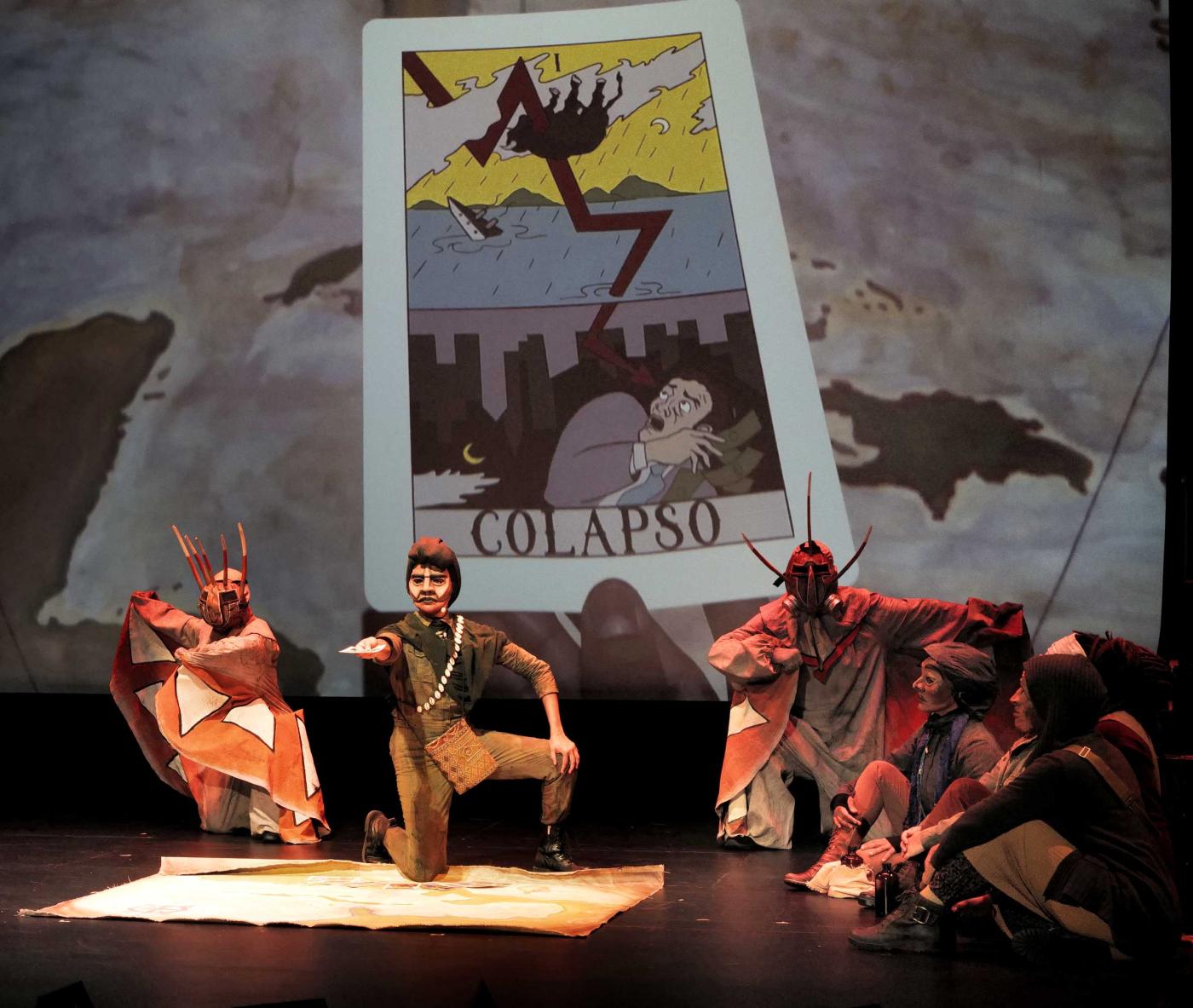
In 2012, NEFA launched NTP, a program of grants and services designed to support the evolving field of devised ensemble theater. With NTP support, Sandglass Theatre toured Babylon: Journeys of Refugees, a response to the worldwide refugee crisis and its impact on communities in the U.S. With the U.S. Committee for Refugees and Immigrants, Sandglass conducted research and interviews with new residents to inform the work which uses puppets and moving panoramic scrolls. From Princeton, NJ, Phantom Limb Company toured their emotional call to climate change, FALLING OUT. Inspired by the 2011 tsunami and Fukushima nuclear disaster, the work fuses the Japanese butoh tradition and contemporary flex dance with puppetry. Santurce, Puerto Rico-based Papel Machete told a story of prison abolition, entitled On the Eve of Abolition | La víspera de la abolición, through multimedia and mask/puppet theater.
Around the same time as the developement and initiation of NTP, NEFA launched Center Stage, a cultural exchange program produced in partnership with LBMI and the U.S. Department of State. Puppeteers participated in the first and final tours of Center Stage. Papermoon Puppet Theatre made their U.S. debut with the program in 2012 and returned in 2025.
Papermoon believes every creature, every object, every single thing in the world holds life somewhere inside of it; learn more about this philosophy in the World Culture in Context video, below, that was created by Center for Cultural Vibrancy as a companion piece to their 2025 Center Stage tour, the final season of Center Stage. With their performances, installations, workshops, collaborations, and festival (Pesta Boneka, an international biennale), they kindle spirits-through the amazing art form of puppetry.
Papermoon’s most recent work, Puno, Sewing Memories, is the story of Tala, a young girl who is coping with her father’s passing and learning about life and death.
Papermoon breaks through cultural barriers that usually separate us from one another, such as differences in language, nation, history, politics, and so on. Words can often fail. With its universal touchstones and emotional, beautiful articulation, Puno and Tala’s story of separation and grief ultimately joins every human being in a shared space of love, memory, and longing.
GELERAN.ID
These themes were also core to the first piece they toured with Center Stage, Mwathirika, which told the personal stories of some of the thousands who were jailed and murdered during the aftermath of an attempted coup against Indonesian leader, Sukarno.
“Though our work is based on family stories, the things that these stories are about have happened around the world,” reflects Papermoon’s artistic co-director and founder Maria Tri Sulistyani. “We want to share Mwathirika with Americans because we want all of us to understand, so it will never happen again. Anywhere in the world.”
Puppets and theater have long helped individuals and communities process grief. A convening held in partnership with HowlRound, Art in the Service of Understanding: Bridging Artists, Military, Veterans, and Civilian Communities, explored the healing potential of theater and dance for service members and their communities.
In the commissioned report on the event, Maureen White writes:
"The creation of art and the creation of war are both part of what it is to be human. Time and again, the conversation returned to the notion that the arts and artistic creation in this context lead to a profound reflection on the human condition. While there is indeed a gap between military and civilian communities, the two are also bound by their shared humanity and the universality of the effects of trauma. Some participants asked, what’s the difference between Sandy Hook, Fallujah, and communities facing police violence? Regardless of the cause, the physiology and psychology of the response are the same. In this way, veterans have valuable knowledge about a significant part of the human experience."
In solidarity with the Black Lives Matter movement after the murder of George Floyd in 2020, nonprofit organizations released statements (including NEFA) committing themselves as partners in the ongoing struggle for racial justice. New England Arts Resilience Fund-recipient The Puppet Showplace Theater in Brookline, MA, established the Creative Residency for Black Puppeteers. The residency, which seeks to diversify representation on their stage and in the field by investing in creative research and early-stage production development by Black puppeteers from Greater Boston and across the country, continues today. The residency is Black-led by project mentor Marcella Murray, community coordinator Tanya Nixon-Silberg, and residency coordinator Ash Winkfield.
NEFA’s support for puppeteers over these first 50 years has been an investment in the healing power of arts and culture. Communities in our region and across the globe experience this when objects are brought to life by social practitioners, culture bearers with messages of hope that demonstrate understanding and inspire transformation.
These puppeteers, ensembles, and presenters maintain their own profiles on CreativeGround, where the region’s creatives, culture bearers, arts and culture organizations, and creative businesses can be found and contacted:
Dig into 295 profiles related to Puppetry
To support regional touring of works, including puppetry:
Our public art programs support artists, including puppeteers, making work in the public realm that inspires more vibrant public spaces and public life:
The PUPA network is dedicated to advancing puppetry in the region. Founded by:
Receive the latest news, grant offerings, and community events.