What's Happening
Stay Connected
Receive the latest news, grant offerings, and community events.

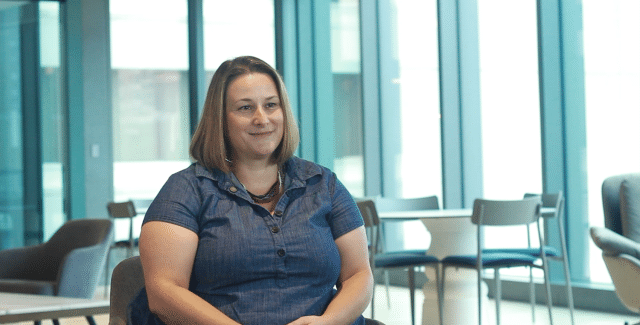
Adrienne Petrillo
Deputy director, regional program strategy Adrienne Petrillo has been with NEFA for 25 years. On this occasion, and in celebration of NEFA’s 50th Anniversary, we sit down with her for a video interview where we ask her 25 questions about her time with NEFA. She discusses her experience as an arts administrator for regional and international programs, the region's unique charms, and the collaborative infrastructure she stewards to keep arts professionals connected, including next week's Idea Swap.
I vaguely remember my first day. I remember a couple of staff members taking me to lunch and finding the local lunch spot. And I remember during that conversation, someone asking me, "Oh, well, what is it you want to do in your career long term?" I was 23 at the time, let's remember. And I gave some answer and they said, "Oh, well, do you want to be a presenter?" And I thought, "I have no idea what that is, but I'm not going to say that." And now here I am 25 years later, and what I do is work with presenters and are constantly explaining what a presenter is.
My first title I think was program assistant creation and presentation. Don't fully remember the words that followed program assistant.
Program assistant and then the program coordinator and then the program manager, program director, senior program director. And last year I was interim director of program strategy and now I am deputy director regional program strategy.
We were small and scrappy nonprofit in some ways 25 years ago and things have been more formalized and programs and staff evolve as they should. But the thing that hasn't changed is our commitment to artists, to organizations, to communities in New England and beyond. I think the work that we're trying to do, the impact we're trying to make has remained the same.
I have been so fortunate to grow at NEFA. I attribute it to yes, hard work, but also some luck and support of people who have come through NEFA along the way. I came in at a place where I was very much like an administrator following a set of tasks and processes, and my job was to just check things off. And now my job is so much more. I mean, strategy is in the title. It is about strategy and thinking bigger picture and taking in all of the years of experience and expertise and continuing to learn and using all of that to inform where we go next.
When it comes to grants, there are deadlines and there are rules and eligibility, but when we can be flexible, we should be flexible. We're here to make the work happen. I will also say I learned from former executive director Sam Miller that 11:00 AM is the best time to call a funder. And from former executive director Rebecca Blanc, always have your passport updated. That has come in handy for my work at NEFA once in a while getting asked, "Do you want to go on this trip to Mexico? Oh, I better check my passport." So keep your passport updated.
One of the things I love about this job is how much I get to interact with artists and organizations in the field. And I'm constantly inspired by the work that they are doing. And I think they are what motivate me every day and help me think about our programs and our work at NEFA. And so I see my job as to also really listen and respond to what they are doing. And so I feel like I'm always in a listening mode when I'm out talking to folks in the field.
When I started to work on the Center Stage program, our international exchange program, that was a real turning point in my time at NEFA up until then. I'd really only worked on our New England programs for the most part. Some of them had a few international connections, but Center Stage was very different. We were inviting artists here as our guests, as guests of NEFA, as guests of the US government, and we really felt a responsibility to host them and be there for them.
And that being there to support those artists and help communities experience their work and experience cultures and art forms they didn't necessarily have access to felt like a real moment of change for me in my time at NEFA.
The trip I went on to Pakistan, by the time I went, we'd already done two other trips to Pakistan. We had worked with, I think like 10 Pakistani artists at that point. And so we went and we were visiting friends and it was wonderful. And one of the groups, Kumarion, had a gig and then they hosted us for dinner that was literally on top of a mountain, scariest car ride I've ever been on in my life. But it was just this incredible experience of being there and being with them and seeing these people we'd built a relationship with but then hadn't seen for several years and being in their home country and having them host us was just such a memorable experience.
I mean, one of my favorite parts about this job is traveling around New England. Last summer I was able to go up to the Abbe Museum for their summer market. Bar Harbor in July, no one's complaining about that except maybe sitting in traffic. But I mean everywhere I've gone is fantastic. Driving up to the White Mountains in New Hampshire, spent a lot of time in Brattleboro, Vermont, which is a really vibrant artistic community. Going down to visit colleagues in Southern Rhode Island. Everywhere we've been is a great road trip.
I grew up in a very, very tiny town in Vermont. It is so small that my high school no longer exists. And when I was there, there were about 75 people in it, but I was fortunate that it was also a very artistic community, had things in the schools, but also outside the schools and it still remains a very artistic community.
And I think I just saw the impact that can have particularly for people who maybe don't have the opportunity to leave their community a lot or to experience other cultures or stories that are different from their own. And so how to provide that opportunity across the region is a big part of what drives my work.
I really like my job. It feels like a nerdy thing to say, but part of why I've been at NEFA for 25 years is I love the actual work that I do every day. One thing I actually really like that might surprise people is reading grant reports because we do read them, but that's our moment to hear about what actually happened. We get an application that is projecting what's going to happen. What actually happened is so fun to read about and the connections that people are sharing, what their community has said to them. And it's just, if I ever need a pick me up, that's the thing to do is read those grant reports because it just reinforces the value of our work.
I just really enjoy sort of putting people together that I think would find some commonality. I sort of consider myself like a matchmaker for arts professional. That is one of the highlights of working regionally is that we can connect someone in Portland, Maine with someone in Fairfield, Connecticut, and they would not necessarily meet. So making those connections across the region is just so satisfying.
I mean, there are a few things you can say, particularly if you work in a performing arts field that I learned over the years. I've had to teach myself to be a little more extroverted. And if you're working with presenters, and especially if it's this time of year, it's the fall, "has your season started yet? How's it going?" Because most presenters work on an academic calendar, even if they're not an academic institution. So a lot of folks are kicking things off in September. So that's always worth asking people. And then in May you ask them, "have you wrapped up? How's it going?" People love to share about what they're doing and it is great to hear about what they're doing.
That is like asking me to pick a favorite child, and I don't know that there's any way to do it without someone getting mad at me. With 25 years at NEFA, I have so many venues and organizations and communities that I love. We are so fortunate in New England that we have such a thriving arts and culture landscape, like smallest little towns, little tiny Putney Vermont that is practically an intersection, has two very significant arts organizations right next to each other. They're like two of the, I don't know, six businesses that are there, and that is very representative of New England, and I appreciate that about this region.
The NEFA staff are so passionate about what we do. They're committed to what we do. I don't know if I want to say all, but most NEFA staff have some artistic background, even if they're practicing or not, even if it's just a hobby or they consider it a hobby, but we all have a touch point with the arts in some way. And I think that really shows in our work and in our commitment to the work.
I think as we look ahead to NEFA's next 50 years, next 25... I won't be here in 50 years, let's be clear about that. Next 25 years, I don't think I'll be here in 25 years either. I'm really excited that I get to be part of shaping the future, I think. I think it's important to reflect on the past, learn from the past, and evolve.
Fall is a busy time for everyone. It's a busy time in New England. It's a busy time at NEFA. One of the things we do every fall is our annual Idea Swap event. It is my favorite event that we do. I'm completely biased. This will be the 24th Idea Swap, so I have planned them all. So I think it's a great event. I think artists and presenters should come. It's a moment where we get to see our work and get to see the impact of our work. We get to see people in person who we might only see on an application form or in an email, and we get to see them talk to each other and build relationships that go well beyond Idea Swap and even beyond and outside of NEFA.
I think for everyone who comes to Idea Swap, I would say to remember that we are all human beings, engage with people, ask them where they went on vacation or what shows they've seen lately that they really loved. And it's not the place to give the hard sell, it's the place to build a relationship and recognize that those relationships take time. It may not happen at just one Idea Swap. You may have to continue to develop that relationship over years. And we do have people who come year after year because it is valuable to them in their work and in those relationships they need to do their work.
What I really would love to hear from folks who come to Idea Swap is actually what the connections are that they've made over time. People don't think to tell us that necessarily. And then I was just reading a grant application the other day that was like, "Oh, we're applying for this artist who we met at Idea Swap in 2022." So it's four years later. I had no idea. No one's telling me that. So I would love for everyone who comes to Idea Swap to share with us what relationships have come out of Idea Swap for them, whether it connected to future NEFA opportunities or not. Just tell us kind of who you met and who you're still talking to.
Lobster roll.
This one's tough because I love the water, but I'm going to say covered bridges.
Cliff walks. If I can go for a walk and see water, I am so happy.
There are lots of them. I will give that caveat. Again, not playing favorites, but if folks don't know about Vermont Cookie Love in Ferrisburgh, Vermont along Lake Champlain, their maple coffee swirl, I highly recommend.
Receive the latest news, grant offerings, and community events.