What's Happening

Stay Connected
Receive the latest news, grant offerings, and community events.
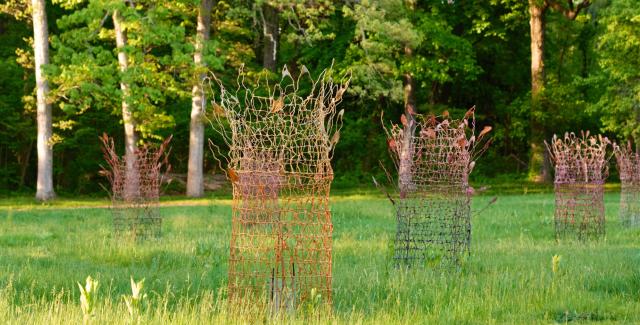
Seaside Chestnuts | photo by Chris Cardoza, Doza Visuals
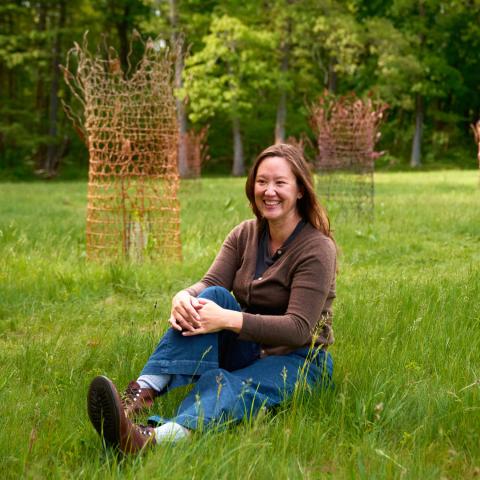
I am a papermaking artist who uses foraged natural materials to craft spacious sculptures, pulp paintings, and installations shaped by place. As a multiracial artist of Taiwanese-Chinese descent, my work is a search for belonging. I relate to plants that tell the stories of entangled ecologies at specific sites. In the studio, I dissolve plant fibers and reconstitute them into paper pulp forms, a collaborative process with materials that emanate place. My work gives opportunities for calm, connection, and nourishment in a crisis-filled world.
In 2021, it made sense to start using living plants in my public artwork. I was already using plant fibers for papermaking. I wanted to make outdoor work that lives, breathes, and changes just as nature does. Could public art become part of a place? Could an art installation become an ecological citizen, existing in beneficial relationship to a site’s stories, joys and sorrows, plants and animals, and people?
I applied to NEFA’s Public Art Learning Fund to pursue a deeper knowledge of plants and ecology, knowledge that I could apply to my public art practice. There were two courses I went through using the PALF. The URI Master Gardener’s program helped to bolster my professional knowledge working with living plants. The Haumea Ecoliteracy course with Dr. Cathy Fitzgerald helped me better frame and communicate my creative work through a better understanding of ecological knowledge.
If you garden, you learn patience and to let things unfold over time. Learning something for your art practice is no different. Over the next couple years, I completed artist residences, group exhibitions, and a couple indoor installations. I also created popular online papermaking courses through my educational website, Paperslurry.com. Yet, no outdoor public art commissions using plants as I had envisioned.
It wasn’t until 2024 that Tess Lukey reached out about a potential collaboration involving outdoor art in the public sphere. Tess Lukey is Aquinnah Wampanoag and the Associate Curator of Native American Art at The Trustees. The Trustees are the largest land trust in Massachusetts, and the oldest in the United States. I think it only took Tess’s brief explanation of The Land Tells Our Stories exhibition concept for me to say, “yes, I’m in!” Three New England artists were invited to create work in response to one of the Trustee’s sites as part of their Art & the Landscape series of original commissions.
Moose Hill Farm in Sharon, MA is right off of Interstate 95, halfway between Boston and Providence. You can see the Boston skyline from Moose Hill. It also has extremely rare, mature American chestnuts growing wild in its forests. Once a common tree species in eastern North America, American chestnuts are now functionally extinct because of a blight that arrived a century ago. Moose Hill Farm also sits on a literal future edge. If the polar ice caps melt completely, the projected edge of the ocean coastlines will rise up to the hill itself. This is the Trustees site where I chose to install Seaside Chestnuts.
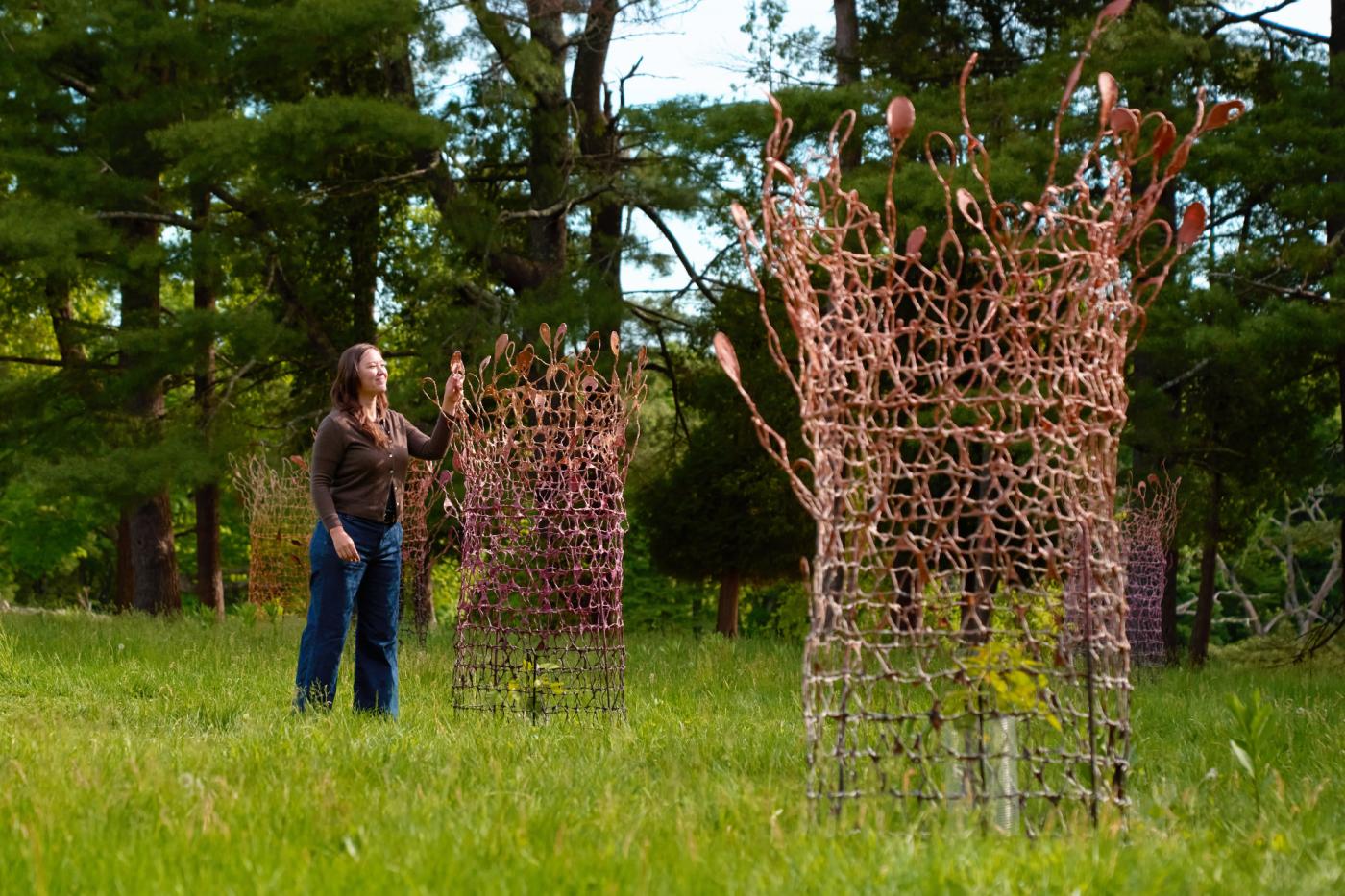
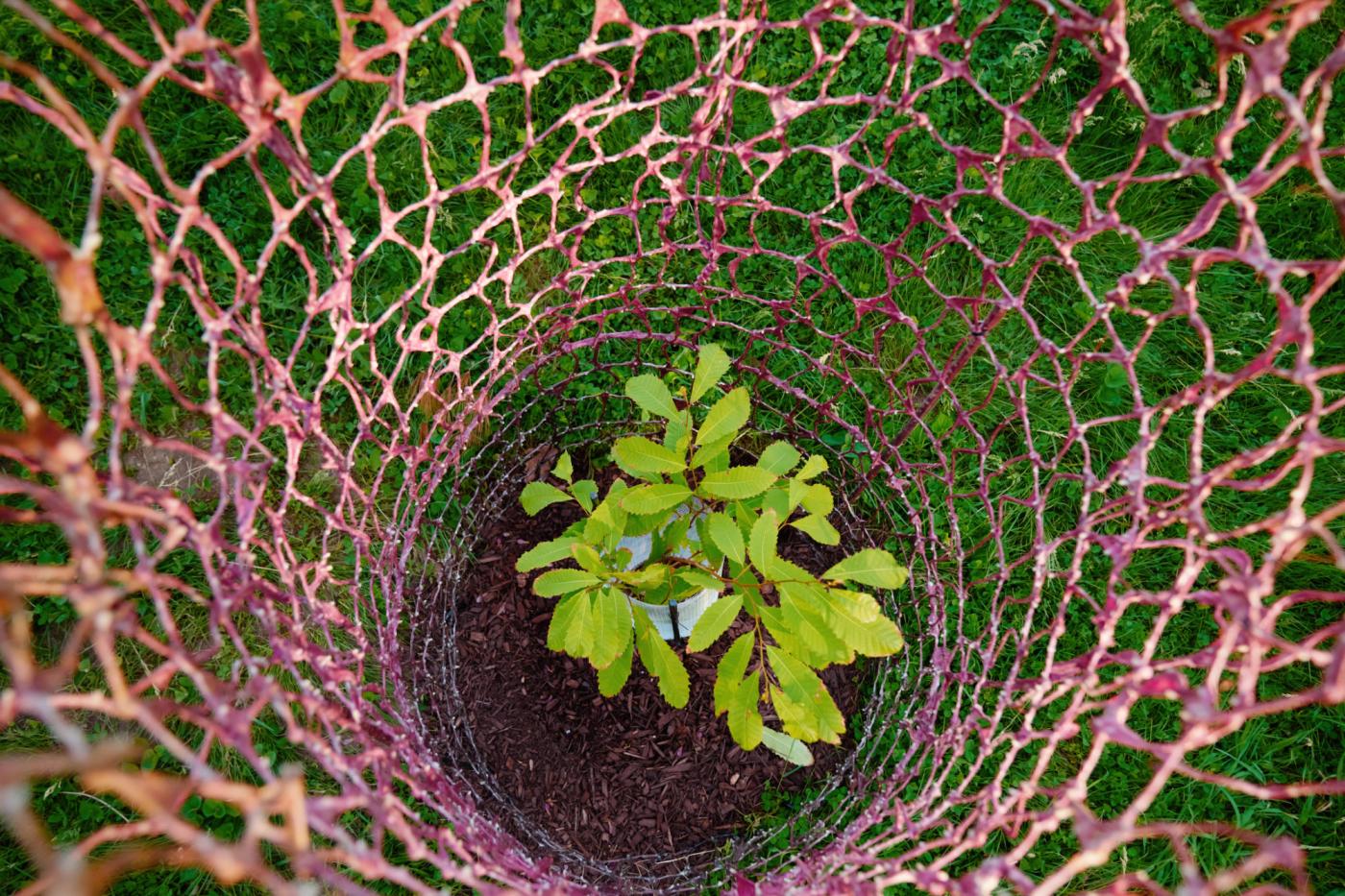
In a meadow at Moose Hill, I installed 11 American, Chinese, and hybrid chestnut trees provided by The American Chestnut Foundation (TACF) and the local TACF MA/RI Chapter. They are on a mission to create hybrid chestnut trees that resist the devastating blight, and I felt a kinship with these more resilient species.
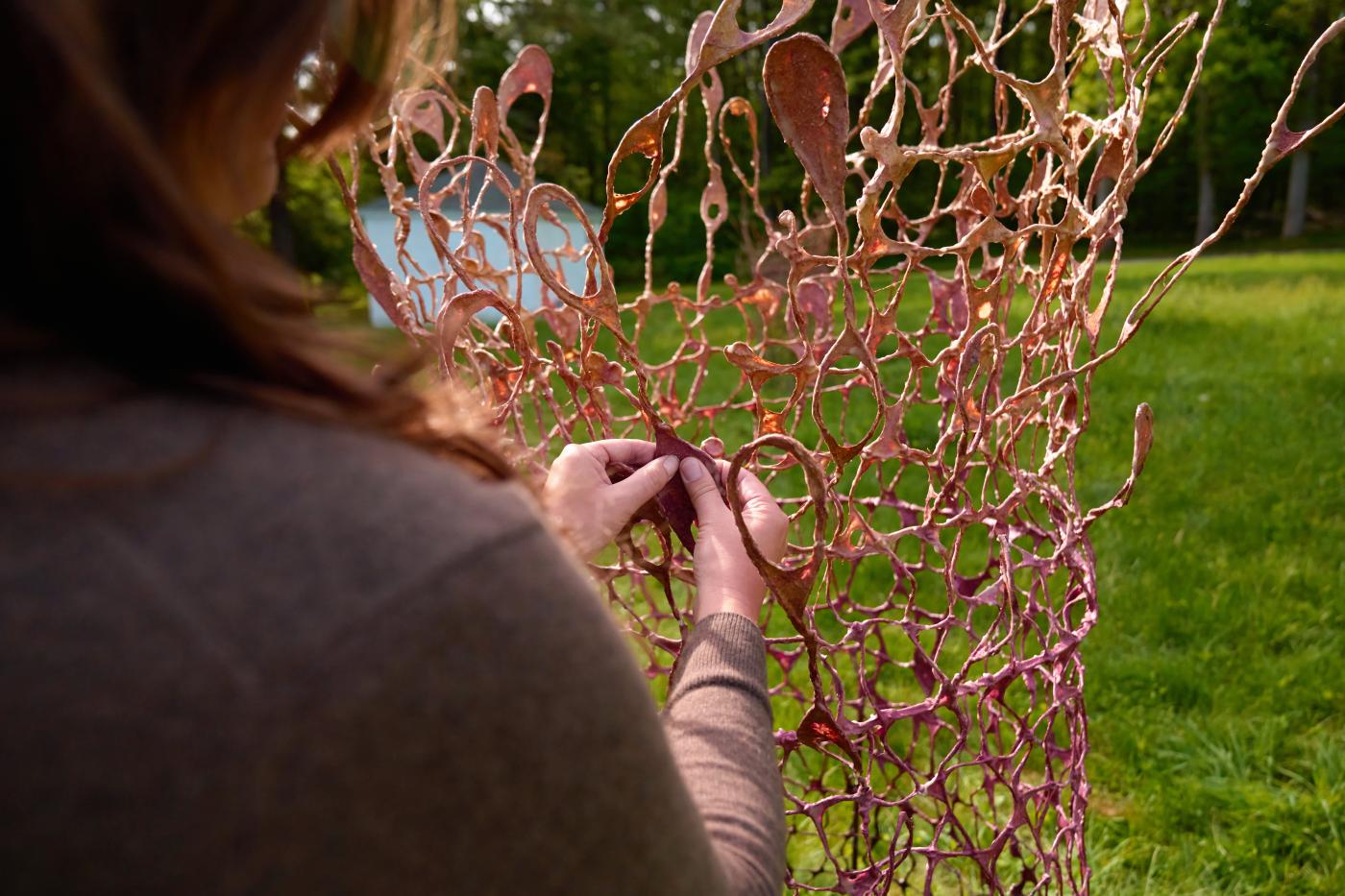
To evoke future coastlines, each tree is protected from deer by seaweed-inspired sculptures made from the farm’s leftover fencing. After making the wire sculptures, I dipped the forms into paper pulp made from a mix of local flax and Moose Hill milkweed fiber, goldenrod, and black walnut.
Flax for hand papermakers is typically imported from Europe, and I wanted to keep it locally connected and regenerative. Kidder Gowen of Hawk and Handsaw Farm in Portsmouth, RI luckily had a barn full of dried flax. Over the winter months, I popped over when I could to help Kidder process the flax using a super old-school wooden tool called a flax “brake.” We also had a community flax-processing day with the Southeastern New England Fibershed.
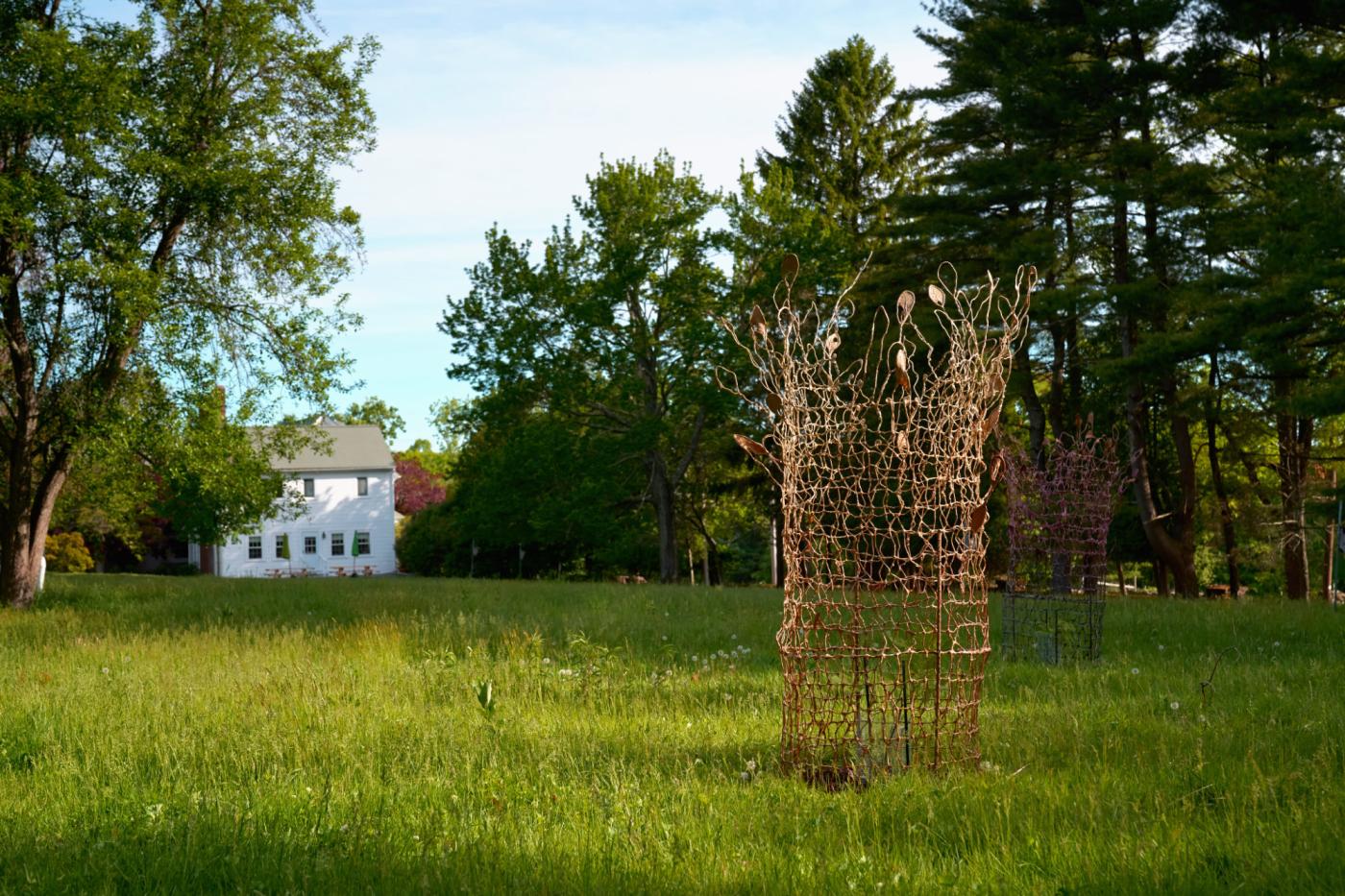
People seem to worry about the impermanence of putting paper outside, because much public art is focused on durability and permanence. If something is impermanent, then you appreciate the present moment, a place where you can find healing, calm, and nourishment. This is something that I hope the work brings to people. The paper will last long enough for the chestnut trees, because of the natural strength of flax, how I pulped it in my Holland paper beater, and a protective beeswax coating. Once the trees are big enough to survive the deer, the protective forms will need to be removed. Incredibly, chestnut trees can live to 500 years.
Seaside Chestnuts dissolves the boundaries between art, site, people, and nature, existing in relationship to Moose Hill. The Cooperative Nature School students and staff help with the watering and did the prior soil testing. Many organizations and people have been so generous with their knowledge, skills, and time throughout this project. Already, the work interacts with nature. During the springtime installation week, rabbits had a nibble in the day between planting the saplings and installing the protectors. The extreme heat waves caused by climate change this summer were too hard for two of the younger trees, and will need replacing in the fall. Milkweed and goldenrod are growing alongside the chestnuts amongst the meadow grasses that grow tall. And if you look closely, spiders spin their webs in the sculptures, finding a new home in the work.
Finally, I invite you to watch the documentary on YouTube:
Seaside Chestnuts is located at Moose Hill Farm, 396 Moose Hill St,
Sharon, MA.
Open
year-round, daily, sunrise to sunset. FREE to all.
Receive the latest news, grant offerings, and community events.