What's Happening

Stay Connected
Receive the latest news, grant offerings, and community events.
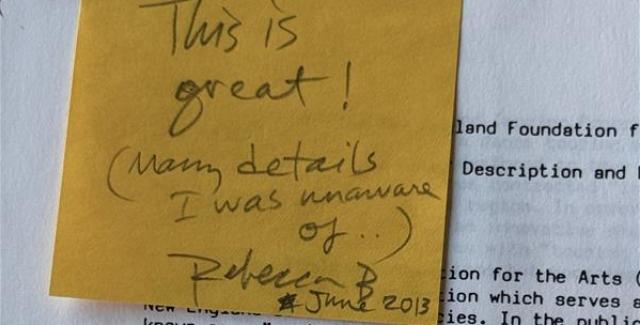
A sticky note from 2013; our executive director at that time, Rebecca Blunk, writes: "This is great! Many details I was unaware of..."
Enjoy this treasured archival document from July 1985! This document, with the full text included below, offers a vivid snapshot of NEFA’s early programs, leadership, and aspirations, and is an inspiring reminder of how far we have come and the enduring values that continue to guide our work.
This document is a part of our ongoing 50th Anniversary Celebration
The New England Foundation for the Arts (NEFA) is a private, nonprofit 501(c)(3) corporation which serves as a consortium of the six New England state arts agencies. In the public sector arts field, NEFA is known as a "regional organization" meaning that it is one of eight multi-state organizational entities officially recognized and funded by the National Endowment for the Arts according to the legislative mandate of the Congress of the United States. NEFA is governed by a Board which includes the executive directors of the state arts agencies of Connecticut, Maine, Massachusetts, New Hampshire, Rhode Island and Vermont, a commission/council representative from each agency, and private members from New England arts and philanthropic organizations.
In 1974, after four groups of states around the country had successfully created regional organizations with funding from the National Endowment for the Arts, the six New England state arts agencies commissioned a study to determine the most pressing needs for the arts in New England. The study, which involved hundreds of hours of interviews with the region's artists, state and community leaders, and patrons highlighted the need for centralized resource sharing and for action in the areas of performing arts touring, visual arts exchange and marketing programs, and services to state arts agencies, especially in the areas of research and technology.
In response to the study, the six agencies agreed to seek funding from the National Endowment for the Arts and collaborate on a pilot program of regional cooperation. The program, which was designed to encourage the exchange of performing groups across state lines, was called the New England Touring Program. It was established in January, 1976 and Dr. Thomas Wolf was hired to run it. Fiscal agent for the program during the first year was the New Hampshire Charitable Fund. However, in anticipation of the need for a more formal organizational structure, the group incorporated itself as the New England Foundation for the Arts, a Massachusetts corporation, on February 25, 1976.
Over the next several years, NEFA developed programs in those areas mapped out as ripe for development. Performing arts touring programs of various kinds were developed to augment the offerings under the original New England Touring Program. These included a contemporary music circuit, a dance touring program, a special "large company" program originally designed to tour theatre, a "Meet the Composer" program, and "in-state" touring programs designed for and contracted by individual states in the region. In order to manage these programs effectively, NEFA established an innovative staff arrangement with its member state arts agencies to share the expertise and knowledge of performing arts specialists based in the state offices who contribute important field input to the regional planning.
In the area of research and services, the Foundation began publishing books, developed a regional computer network, and took on research contracts for public and private agencies. Its first publication, Presenting Performances by Thomas Wolf, became a best seller in the arts administration field, as it provided a much needed presenting primer for the growing network of community arts organizations. The Arts and the New England Economy, published in 1981, made public a NEFA study, undertaken with funds from the United States Department of Commerce, which documented the economic impact of the arts on the six-state region. Another study of equal public policy import was published in 1983. Art Work: Artists in the New England Labor Market spelled out the disturbing facts of employment and training for New England artists. In collaboration with educators from throughout the region, Arts Go To School was authored in 1983 as a manual for schools and artists involved in residency activity. In the data processing field, NEFA played a leadership role in developing the National Information Systems Project, an effort to develop compatible computer standards for the public arts field.
In visual arts, a regional touring program was initiated in 1978 after an extensive planning process. The original program offered grants to institutions which could develop travelling exhibitions for NEFA. Once prepared for travel, NEFA established touring circuits for the shows and made all travel arrangements. This program resulted in a strong regional network of exhibiting institutions committed to sharing their outstanding collections. In response to a growing demand, NEFA also developed a grants program for the sponsorship of important exhibitions from outside the region and a media program which tours film and video work of regional and national artists. In recent years a focus on the development of audiences for contemporary work has resulted in tours by performance and multi-media artists.
After a comprehensive board-staff planning effort and with the support of a major grant from a private trust, the Foundation embarked in 1983 upon a three-year program which is expected to further the relationship between the region's artists and audiences. These funds will allow the Foundation to expand the geographical distribution of arts programming in the region; to help community presenters extend the reach of their programming, often to include experimental, risk-taking work; and to investigate alternative markets and networks for the distribution of New England artists' work.
The New England Foundation for the Arts is an example of an innovative public-private partnership shaped to provide critically needed support to the audiences and artists of its region. With funding from private, corporate, state and federal sources the Foundation reaches over 3,500 local arts presenters who regularly offer arts programming to their communities. This network provides essential support for the preservation and nurturing of New England culture and the artists who infuse it with new ideas and interpretations.
7/85
Ad Hoc Advisory Groups:
The visual and media arts programs foster resource sharing and strive to broaden audiences for significant visual and media arts exhibitions. The programs were designed to ensure both diversity of content and high artistic standards in visual and media arts exhibitions enjoyed by the region's audiences. The exhibition rental program maintains a roster of outstanding visual and media arts exhibitions, most of which the Foundation helped to develop. These are available for rental by New England institutions at fees significantly below the actual cost of developing and touring the exhibition. These Foundation-circulated exhibitions are often the only means by which some small institutions can afford exhibitions of such high artistic and educational quality.
Exhibitors consult visual arts/media staff on the availability of suitable exhibitions, taking into consideration the exhibitor's audience and the security rating of the exhibition facility. Foundation staff makes arrangements for the exhibition to travel to the exhibitor's site and provide educational and promotional materials which help the exhibitor reach community audiences. As a special educational supplement to the touring exhibits, the Foundation also provides funding towards visits by artists and curators whose work is represented in the traveling shows. These provide unusually effective opportunities for expanding understanding of the artists and their work. About 100 exhibition rentals take place annually. Touring exhibitions are developed through the exhibition grants development program. Institutions may apply at three times during the year for assistance in developing exhibitions that the Foundation will tour for at least a year. The applications are reviewed by a panel of visual arts experts, one from each New England state. Priority is given to exhibitions of high artistic quality which demonstrate innovation and commitment to expanding audiences for the work. In addition, great attention is given to choosing exhibitions of all sizes and security levels and which present diverse art genres and media. This program is extremely competitive, funding ten new exhibitions each year.
Exhibitors may also apply for financial assistance in borrowing exhibitions from sources other than the Foundation. Again, the applications are reviewed three times annually by the same panel judging exhibition development proposals. The criteria for funding emphasize the artistic quality of the exhibition in question, its importance to the exhibitor's regular constituency, its educational content and financial need of the exhibitor. About 20 grants are made annually.
Contemporary Projects makes available to New England presenters a limited range of contemporary artists who work in multidisciplinary,
experimental modes and who are less familiar to New England audiences. This program attempts to help presenters throughout the region develop audiences for risk-taking contemporary work of the highest quality. A small roster is developed each year in consultation with regional presenters to offer a sampler of some of the most exciting developments in avant garde art in both traditional and new disciplines. Recognizing the financial risk incurred by presenters of the avant garde, Contemporary Projects assistance may extend as high as 50 percent of the cost of presenting one of the roster performers or groups.
Ad Hoc Advisory groups*
*These groups of 3-6 members each are convened when needed to provide expertise and planning assistance in their respective areas.
The performing arts program of the New England Foundation for the Arts administers grants programs which aid local organizations that present the performing arts to New England audiences. The program was designed to encourage New England performers todevelop audiences beyond their home bases which would in turn stimulate high quality arts programming at the community level throughout the region. The grants awarded to community organizations through the performing arts program are in the form of partial payments towards artists' fees. Since the program is intended to encourage new presenters of the arts, the application process is simple and streamlined. Presenting organizations can apply to the Foundation at any time of the year for this support: their applications are reviewed monthly by a panel of performing arts specialists from the New England state arts agencies. Priority is given to presenters who reach traditionally underserved audiences and who make serious and innovative efforts to broaden audiences' appreciation for a wide variety of arts offerings, including contemporary, risk-taking work. An average of 1,500 awards are made annually to the region's presenters under the auspices of this program.
Presenters are eligible for Foundation performing arts subsidies under four programs: New England Touring, Live Literature, Meet the Composer and Special Projects. New England Touring, the oldest and best known of the Foundation's programs, was begun in 1977. The program features a roster of professional performing groups from New England that have been selected annually in a highly competitive process. In order to achieve placement on the roster groups must demonstrate outstanding artistic quality and a commitment to touring. When community organizations engage these roster ensembles, they are eligible for up to one-third subsidy of the performance fees. The performing arts division operates three other programs designed to bring contemporary creative artists and audiences together. The Meet the Composer/New England and Live Literature programs offer up to one-half of artistic fees to regional presenters that schedule public appearances, performances or residencies by composers and writers. Under Special Projects the Foundation, often in partnership with the National Endowment for the Arts, provides special fee support to presenters that introduce artists from outside the region to their audiences. In past years such initiatives have been carried out in the fields of dance and theater, providing New England audiences with extraordinary opportunities to view the excellence and diversity of the nation's premier performers.
In addition to administering grants programs, the New England Foundation for the Arts provides research and information services to the public, to presenters and roster artists, and to the state arts agencies.
From its inception the Foundation has undertaken research projects tied to the policy-making needs of the state arts agencies and to the practical needs of the presenter network. Ranging from examinations of the impact of the arts on the economy to the use of arts in the schools, these research projects have resulted in the publication of a number of books of national as well as regional significance.
In the process of operating its programs the Foundation has also amassed tremendous amounts of data about arts activity in New England. The data, which includes a variety of mailing lists and performing and visual arts facilities information, is available to the public at cost. Through agreements with other regional agencies, the Foundation is also able to make similar data from other parts of the country available to New England users. The Foundation provides computer and information services to the six state arts agencies forming the consortium. Housing an IBM Series I minicomputer, the Foundation offers time-sharing and data base management assistance to the state arts agencies. The Foundation's Information Services division helped to develop andnow maintains the informational standards by which state agencies are able to exchange information among themselves and with other agencies throughout the country. Twice a year the Foundation hosts meetings of the state agencies' computer users to discuss applications of computers to agency management challenges.
7/85
Receive the latest news, grant offerings, and community events.