What's Happening
Stay Connected
Receive the latest news, grant offerings, and community events.
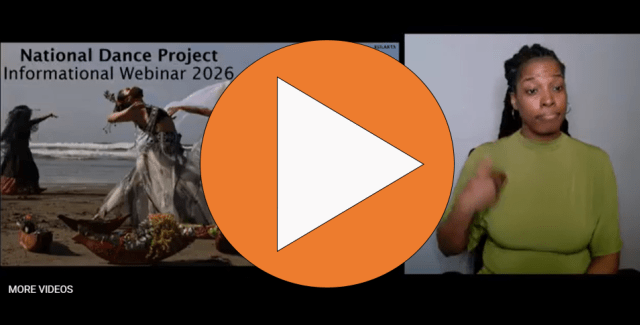
National Dance Project Production Grants are made to projects led by professional choreographers or companies to support the creation and U.S. touring and/or sharing of a new dance project.
Indira Goodwine-Josias (IGJ): welcome and thank you for joining us for this 2026 National Dance Project Production Grant Informational Webinar. This is Indira speaking. It is NEFA's practice to share a land acknowledgement for all convenings, including the virtual space we are in today. We believe that a land acknowledgement is necessary, yet only a first part of a much more engaged process towards deeply rooted healing and reconciliation. We see the role of the arts as an opportunity to uplift and uphold truth and recognize our responsibility to not perpetuate the erasure of people. Therefore, as a committed ally and as artists, NEFA wishes to acknowledge that the grounds on which our offices are located are the traditional current and future lands of the Massachusett, Naumkeag, Nipmuc, and Wampanoag peoples. We recognize that many indigenous peoples have come to this place and the connection between displacement and removal, so we honor their presence. We also acknowledge the many indigenous people and lands where our distributed staff live and work, including the NDP team who are leading today's informational webinar from the lands of the Mohegan, Massachusett, Pawtuckett, and Lenni Lenape people. We honor their ancestors' past, present, and future, and recognize their continued existence and contributions to our society. Furthermore, we recognize the many native lands in which all of you are joining us from across the country and respect the choices you make in honoring and recognizing the caretakers of those lands. It is also important to acknowledge those of you viewing and your respective ancestors who did not come to this land by choice and those who did. Since our activities are being shared digitally to the internet, but let's also take a moment to consider the legacy of colonization embedded within the technology, structures, and ways of thinking we use every day. Even the technologies that are central to much of the art we make leave significant carbon footprints contributing to changing climates that disproportionately affect indigenous people worldwide. We feel it is important to reflect on this as we continue to use these digital spaces to connect. I invite you to join us in acknowledging all of this, as well as our collective responsibility to make good of this time and consider our roles in decolonization and allyship. We will now pause for a moment of silence to honor and reflect on the deep history of these lands and its people. Thank you. Hello again, and thank you for joining us for today's informational webinar. While our cameras will remain off to highlight slides, we are sharing an image of who we are and will acknowledge how we identify at this time. My name is Indira Goodwine-Josias, and I am the senior program director for dance at NEFA. My pronouns are she/her, and I am a Black woman who in this image has straight shoulder length hair and is wearing a blue blouse with white pearls around my neck and matching earrings.
Cheri Opperman (CO): Hello, my name is Cheri Opperman. I am the senior grants manager for dance at NEFA. My pronouns are she/her, and I am a white woman who in this image has shoulder length, brown and gray hair, wearing a blue shirt and blue earrings.
Kristin Gregory (KG): This is Kristin Gregory speaking. My pronouns are she/her, and I am the program manager for dance at NEFA. I am a white woman who in this image has long light brown hair, and I am wearing a teal V-neck sleeveless top.
IGJ: This is Indira speaking. This informational webinar will provide important information related to the 2026 NDP Production Grant Application Process inclusive of information about New England Foundation for the Arts (NEFA), information about the National Dance Project (NDP), NDP's production grantee and finalist framework of support, expanded definitions of touring or sharing, grant eligibility and funding criteria, how to access the NDP application, a review of the NDP application narrative questions, work sample submission instructions, and a full NDP production grant timeline review. As a reminder, everything that is shared today can also be found on NEFA's website at www.nefa.org. As one of six regional arts organizations, New England Foundation for the Arts was established with funding from the National Endowment for the Arts to strengthen regional arts opportunities. Today, NEFA's programs are regional, national, and international in scope, and support artists and communities through grants and other opportunities in dance, music, theater, and public art. In September of this year, NEFA unveiled its 2025-2030 strategic plan, entitled "A Mission Forged in Collaboration." It is a landmark framework that reaffirms NEFA's identity as a social impact organization and sets forth a bold agenda for the future of the cultural sector. NEFA's new mission states as a social impact organization, NEFA builds, sustains, and fights for arts and culture through grantmaking, partnership, and advocacy in New England, the nation, and beyond. And we envision a world where the arts and culture ecosystem thrive, artists flourish, and the transformative power of the arts is valued as essential to a more vibrant and equitable society. To affirm NEFA's commitment to dismantling inequities, building authentic partnerships, and responding with agility to evolving needs, we have identified the following guiding values as we enter this next chapter as an organization. Cultural rights and responsibilities: we believe the freedom to create, access, express, and share arts and cultures are human rights and essential to a just society and thriving community. Reciprocity: we understand that building our collective future relies on teamwork, collaboration, and partnerships at the intersections of art services, philanthropy, and social justice, and we center each other's humanity through just and mutually beneficial relationships. And lastly, adaptability: we believe that adapting to social and environmental change ensures the sustainability, resilience, and vitality of cultural communities. So we remain committed to engage dialogue with artists, colleagues, and organizations to understand their needs and inform the design, implementation, and flexibility of our work. Established in 1996, the NDP Production Grant has remained committed to the creation and development and US touring or sharing of new dance projects. To date, NDP has invested more than 51.5 million in funding primarily to support experiencing live dance, including production residencies and regionally focused professional development for dance artists. Over our 30 year existence, National Dance Project has been widely recognized as one of the country's major sources of funding and field building for dance. This has been made possible with generous support from the Doris Duke Foundation and the Mellon Foundation. As most of you know, there continues to be shifts in both public and private philanthropy that impact many individuals and organizations, and NEFA and NDP are no exception. So it is with deep sadness, we share that the 2026 NDP Production Grant Cycle will be its last. In recognition of our 30 years of steadfast support and service to the field of dance, this year's production grant cycle will award 30 NDP production grants and 30 NDP finalist awards. This is an increase from the 20 NDP production grants and the 20 finalist awards we have provided previously. While we will continue to offer a comprehensive funding framework for the production grant, as well as unrestricted funds for finalist awards. There are some shifts that impact the total number of resources provided and our overall grant making process for 2026. This webinar is designed to guide you through these changes and prepare you to submit your most confident application.
CO: This is Cheri speaking. Today, we'll be talking about our major grant program, the NDP Production Grant, which is inclusive of creation and US touring support, and this year we'll award 30 production grants and 30 finalist awards through a highly competitive application process. These comprehensive grants are made to projects led by professional choreographers, companies, or collectives. This framework of support is comprehensive and includes $45,000 to artists, companies, towards all costs associated with making the new project. $10,000 to artists companies for general operating support. With deep thanks to the Doris Duke Foundation, this funding is totally unrestricted. For instance, it can be used for salaries, rent, insurance, retirement, computers, cameras or other equipment, tour coordinator or administrative support, or you can put it towards the project, really anything. Production, creation funds, and general operating support. These funds are paid directly to the artist/company, if they are a nonprofit or to their designated fiscal sponsor. Additionally, $20,000 is reserved for each project's US tour and is allocated by the artist company to US-based organizations to subsidize a presentation of the NDP funded project and must be used during the work's NDP touring period. Tour funds are allocated by the artist designated tour coordinator and distributed directly to the presenter through NDP presentation grant process. Tour coordinators may be an agent, a manager, or the artist themselves, and NEFA defines the United States as all 50 of the United States, including Alaska, Hawaii, Washington DC, as well as Puerto Rico, Guam, the Northern Mariana Islands, the US Virgin Islands, and American Samoa. Our NDP Production Grant finalists. In addition to the 30 full production grants that will be awarded through the panel review process, 30 new dance projects will receive an NDP finalist award of $10,000 in unrestricted funding. This may support the artists as they continue to create or tour or share the project or for sustainability needs. Expanded definitions of touring. NEFA recognizes that our social climate continues to impact the ways that artists create and intend to share their work. We value their continued ingenuity through changing times and the artistic experiences they choose to share with communities and audiences, whether in person, virtually, or some imaginative combination of both. Additionally, NEFA understands that there may be opportunities and interests in artists and companies to share their work virtually, reaching a more global audience. And while we support the many ways artists and companies have been able to expand their reach, it is important to note that the NDP tour subsidy can only be allocated to US-based organizations. This, of course, does not prevent an artist or company from securing opportunities outside of the US. However, we must be clear about how tour subsidies can be allocated and distributed. Our production grant funding period. For NDP production grant recipients, their window during which they must use the creation funds and touring subsidy. If you or your company's project is selected as an NDP production grantee, the window of time you will have to create, tour, and/or share your project is October 1st, 2026 through December 31st, 2028. Please note, touring subsidy can be used for the premiere of the NDP supported project. We understand that this production grant funding period is significantly reduced from what we have offered in the past. However, as we desire to close out the program with care, we must balance that with our capacity to steward both new and current grantee projects.
KG: This is Kristin speaking. To be eligible to apply for a National Dance Project Production Grant, applicants must be able to meet the following criteria at the time of application submission, which will be March 16th, 2026 by 11:59 PM Eastern Standard Time. These eligibility requirements are also always available online at NEFA.org. A note about eligibility for the 2026 funding cycle: we have updated and added some new elements to our applicant eligibility requirements. I will note those new changes and additions as I go through the next few slides. Applicants must be professional choreographers or companies. Preference is given to US-based stance artists and companies, but artists and companies based outside the US may apply. Please keep in mind that all NEFA funds must be paid to US-based organizations. Applicants must have nonprofit status or a nonprofit fiscal sponsor who will act on their behalf. If you do not have nonprofit status, you may work with a fiscal sponsor.
You do not have to have a fiscal sponsor or nonprofit status confirmed in order to apply, but you will need one to receive payments should your project be awarded. We are not able to make grant payments to individual artists, LLC entities, or organizations incorporated outside of the US. Applicants must propose a new dance project to be developed and toured/shared. Projects may be interdisciplinary and can include creators in other artistic forms. At the time of application, projects may be in an early, mid, or late stage of development. Projects may explore hybrid art form. We recognize continued and evolving ideas of dance and movement-based expression. However, the grant will be evaluated by a dance panel, and there is an expectation that the focus of the project will have a movement-based practice or process. Applicants must submit or appear in only one application per choreographer or company, including applications for a project that will be created by a guest choreographer on another company.
Applications, including a work that will be created by a guest choreographer on another company are considered to be part of the one application per choreographer company. If you are a company interested in submitting an application with a guest choreographer, please be in touch with that choreographer to ensure that they themselves will not be applying or that they have not given permission to another company to apply as well. Applicants will be expected to fill the requirements and reports for grant recipients if awarded. The next eligibility requirements are new or updated for 2026. To ensure this grant supports the sharing of new work across multiple groups, communities, and audiences, projects must adhere to the following timeline. Premiere after September 30th, 2026, complete all project activity and use of NDP tour subsidy by December 31st, 2028. Applicants must work with a minimum of two US-based organizational partners committed to supporting the development and/or engagement of the proposed new dance project. We will go into further detail about what constitutes an organizational partner and the kinds of resources partners may provide to a project later in this presentation. Applicants must work with a minimum of two US-based touring partners committed to the presentation of the proposed new dance project within the grant timeline identified above. We will go into further detail about what constitutes a touring partner and the kinds of resources partners may provide to a project later in this presentation. At this time, we cannot accept applications that fall within the following categories. Artist companies currently in a creation period from an NDP production grant or who are currently touring with NDP support are not eligible. If you are a current National Dance Project Production Grantee and have not completed all aspects of the project supported by NDP funding, including touring, you are not eligible to apply at this time. If you have recently received NDP support and are not sure about your status, please be in touch with us as this varies by project. We will only discuss the eligibility of a project with the artists who are associated.
Artists companies with an overdue grantee report for any NEFA program are not eligible. To regain eligibility, outstanding grantee reports must be submitted online to NEFA by February 1st, 2026. If you have an overdue grantee report with any NEFA programs, we will not be able to accept a new application, but please be in touch with us to restore your eligibility. Grantee reports that are outstanding must be submitted and approved by NEPA staff prior to the application deadline. Any outstanding grant reports can always be viewed in your account through our online portal. Please note, if you are a New England-based artist or company and are a grantee of another NEFA program and have concerns about your eligibility based on your other grant status, please contact an NDP team member to confirm your eligibility. If a project has received an NDP finalist award more than once since 2020, NEFA will not accept an application for the same project for the 2026 grant cycle.
Please contact NDP staff to confirm eligibility before applying. In an effort to ensure equitable distribution of resources to an increasing applicant pool, NEFA will not be able to support finalist funds for a singular project in excess Of $20,000. Artist companies who are planning to self-produce their NDP tour are not eligible. NDP tour subsidies support up to 50% of the artist's fee per engagement and are paid to presenters on a reimbursement basis. Tour subsidy cannot be paid to the artist company receiving the NDP production grant. NEFA defines a self-produced tour as engagements which are being mainly supported financially by the touring artist or company. Again, NDP tour subsidy cannot be paid to the artist company receiving a production grant, also referred to as a grantee, and therefore engagement supported by touring subsidy must have some kind of artist fee associated with the engagement that is paid to the artist company by a separate entity. The separate entity is then reimbursed by NEFA via presentation grant for a portion of that artist's fee. The kinds of organizations that may receive presentation grants as part of a grantee's NDP supported touring sharing period are varied. We do not strictly mean performing arts centers and dance presenters. Many kinds of 501 nonprofit organizations can receive touring subsidy as part of an NDP touring sharing period. Pools, youth, or student companies and groups are not eligible. We are not able to support projects that are working primarily with youth under 18 or students, especially if those youth are the main performers, which does include college students. The primary artists involved in the creation and performing of the work should be professional, which generally equates to paid, though there is some nuance within that definition. Artist companies creating dance projects that are specifically made for dance, film, or camera are not eligible. The intention of the production grant program is to support a live engagement of some kind. Film may be associated with the engagement, but there should be an intention of live performance happening in association with film. Given the current landscape, we understand this may be happening virtually. We are looking for the intention of live performance, whether that can realistically happen continues to change. We understand the complications and nuances of this. Funding criteria. All grant applications are evaluated based on the following criteria. Myself, Cheri and Indira have no role in determining the projects that will receive NDP support. The selection process is guided by a rotating group of advisors who are leaders in the dance field, including dance artists, presenters, administrators, independent arts consultants, curators, educators, and social justice practitioners. Collectively, they are responsible for selecting the 30 projects that will receive the NDP Production Grant and serve as the policy and accountability council for NDP's overall process. The information about who will be serving in this role will be available on our website prior to the grant deadline. Though we acknowledge that these individuals cannot amply account for the richness of diversity within our field and country, we remain committed to uplifting new voices and perspectives each year as part of our process. The process of selecting and guiding these individuals is done with deep consideration and commitment to our values. We seek individuals who represent various communities and life experiences that will support the assessment, evaluation, and discussion of applications during the grant panel meeting. As decision makers, NDP advisors understand the impacts of equitably distributing resources and intentionally prioritize countering against structural inequities that have excluded individuals and communities from opportunity based on race, gender, disability, sexual orientation, class, culture, language, age, and geography. These advisors evaluate each application individually based on the following criteria: support new dance projects within a range of cultural and aesthetic diversities that bolster today's dance field, support the creation/development of new dance projects that demonstrate excellence in artist practice. Support new dance projects that will tour, be shared in multiple communities in US and its territories. Applications must include at least two US-based touring partners. Artists are welcome to share their work internationally, but keep in mind, we are not able to distribute NDP funds to international organizations. Therefore, this program is not able to financially support those engagements. Reflect partnerships with organizations that are essential to the realization of the proposed new dance project. Applications must include at least two US-based organizational partners and demonstrate a commitment to an accessible engagement process with four communities and audiences because of the new dance project's relevance, originality, and/or timeliness. Applications should reflect engagement practices and processes that consider and include access needs specific to the projects identified communities and audiences.
CO: This is Cheri speaking. For the organizational partner overview, NDP believes strongly in artist organizational partnerships to strengthen the development of new projects and to connect communities to dance. As part of your application, you will need to identify organizational partners that will support you in reaching the goals of your project, which can range from research to creation to community engagement, and while projects may have more than two partners, you must list at least two on the application form, and you should include information about additional partners in the narrative section. The National Dance Project defines organizational partners as US nonprofit organizations who have working relationships with dance artists or companies and are committed to providing support for the creation and/or engagement activities. Organizational partners can be community-based, institutions of higher education, cultural organizations, or producing or presenting performing art centers, et cetera. The organizational partner is not required to present the finished work at any time, though some may do.
An organizational partner may provide a variety of resources during the creation and engagement activities of a project, including but not limited to, access to communities who will be involved in the research, creation, and engagement activities, residency space, mentorship, commissioning support, administrative guidance or support, research advocacy, research assistance, marketplace advocacy, and the leveraging of additional funds for the project. The organizational partners do not need to be presenting or presenting organizations. Additionally, the applicant should demonstrate how the partnership is supporting the New Dance Project, and it is also beneficial to understand how the partnership might support the goals of the organization, demonstrating reciprocity in the relationship. Please note, on the application, there is an organizational partnership narrative question to lift up the relationships and support you may be receiving from any all organizational partnerships. Additionally, there will be a tab where you are required to enter two organizational partners that meet the minimum eligibility requirements. You will have an opportunity to list additional partners in this same tab, but please make sure the first two meet the eligibility requirements to ensure your application makes it to the review stage.
Touring partner overview. The National Dance Project defines touring partners as US nonprofit organizations that will present engagements of the NDP supported projects and receive NDP tour subsidy during the grant touring period. NDP tour subsidies may support up to 50% of the artist's fee, including housing, per diem, and travel. On the application, there is a touring partnership narrative question to uplift touring partnerships for any and all future presentation engagements of the proposed new work. Additionally, there will be a tab where you are required to enter two touring partners that meet the minimum eligibility requirements. You will have an opportunity to list touring partners in the same tab, but please make sure that the first two meet the eligibility requirements to ensure your application makes it to the review stage. If an organizational partner is also presenting the NDP supported project during its tour, that organization can be listed as a touring partner in the application and would fulfill the requirements in both areas of the application. Please note, applications that demonstrate a range of relationships amongst both organizational and touring partnerships would be more likely to exceed the NDP production Grant criteria.
KG: This is Kristin speaking. The following slides will offer some insight for how to submit an application to NEFA, as well as some tips and important information about our new online grant portal. Before you begin a production grant application, you will have the ability to preview the application narrative questions that you will be required to answer at any time. These questions are available on the production grant informational page by clicking the preview application questions hyperlink from the gray box located on the upper right-hand side of the page. Instructions for how to start a new form. When you are ready to start an application, scroll down and click on either apply now or return to your grant application button from the same location in the gray box. This will bring you to the login page for our portal. In 2025, we transitioned to a new portal platform. While not everyone submitting an application in 2026 will have to create a new account, some of you may need to if you have not applied to a NEFA program since the transition to our new portal. To create a new account and log in, please click new user at the bottom of the portal login page. Please only do this once and remember to write down or save the login credentials we create. NEFA staff cannot view your current password or create a new password for you. Unlike in our older system or this new system, you will use your email address as your username. The new user button will direct you to a page where you will create a profile. You will only need to do this once. The system will remember this information and some of it will auto fill into your application for you. You can change your profile information anytime after your initial account creation. Organization or individual. If you are applying as a legally registered entity in any capacity, be it as a 501 or LLC, then select organization. If you are applying as an individual choreographer or artist, select individual. If you are not sure, perhaps the following information about what will be collected for each option may help you determine which category to select. Please note, the determination you make at this stage has no effect on how your application is received. This is a data collection method only. Required information for organizations. At the time of your account creation, organizations will be required to enter the following information. Required organizational legal name. The name that your organization has been legally registered as. Required organization public name. This is your doing business as name. Required organizational EIN or federal employer ID, also known as a tax ID. Only legally registered entities will have this. If you are an LLC, you may have to enter 00-followed by seven more zeros. Please do not ever enter your personal social security information into this or any other field in our portal. Required unique entity ID or UEI. Again, legally registered entities will have a UEI. To get your UEI, please visit sam.gov. That's S as in Sam, Sam.gov. If you do not have one yet, you may enter 12 zeros into this field for the time being. Required. Institution type. Please select the option that best represents your organizational structure. Required. Legal status. Please select the option that best describe how your organization have been legally registered in the US if applicable. Please note. This category is in no way a reference to or request for information about citizenship or immigration status. Required artist discipline. Please select the option that best represents your form and aesthetic. Please note the options for the last three data collection fields mentioned have been predetermined and NEFA has no say in the category options. These selections have no effect on your application. Optional organization website. Optional Creative Ground Profile. Only New England-based organizations will have a Creative Ground profile. You may skip this if you do not have one. Required contact information. Please enter the information for the person that grant staff should reach out to regarding questions about or issues with your application. Please note the email you enter in this section will become your username. Please remember which email address you enter. Required. Please enter the address where your organization is legally registered. Required. How did you hear about NEFA? Select all that apply. To select multiple options, hold control on your keyboard when you add a new option to your selection. Required information for individuals. At the time of account creation, individuals will be required to enter the following information. Required first and last name of applicant. Required. Occupation. Please enter any titles you feel are relevant. Required. Phone number. Grant staff may need to contact you regarding your application. Please include the best number for you to be reached at. Required. Email. Grant staff may need to contact you regarding your application. Please include the best email address for you to be reached at. Please note the email you enter in this section will become your username. Please remember which email address you enter. Optional Creative Ground Profile. Only New England-based artists will have a Creative Ground profile. You may skip this if you do not have one. Required, please enter your current mailing address where any potential grant documents would be best inclined to reach you. Required. How did you hear about NEFA? Select all that apply. To select multiple options, hold control on your keyboard when you add a new option to your selection. Finish registering. Please check your email. NEFA staff cannot support you in this step. We cannot send you a new email. You will receive an email with a link to create a password. Please create a password you can remember or save it somewhere. Again, NEFA staff cannot recover your password for you. If you lose your password, you can use the "forgot password" link on the portal's main login page. You should now be logged in. After you have created account, stay logged in and in a separate browser table window, return to nefa.org to select the Apply Now button in order to be directed to a new blank application form. This is the only time we will ask you to click the Apply Now button twice. A few notes about the portal. The save my progress and resume later check mark in the orange box will not actually save your application.
You have to select the check mark and then select the save in the box that will appear after selecting the check mark. Saving your application will take you out of the application every time. We are sorry. We cannot change this. Additionally, any information entered in the application will not save unless you actively save your work. We highly recommend working from a word or other kind of document and copying and pasting everything into the form once you are completely ready to submit to save yourself and us frustration. Unfortunately, there is nothing we can do to get back any information entered, but not saved. Please pay attention to character counts. We cannot do anything to help you if you go over character limits. The form will not allow you to submit, and we do not have the ability to override this. Character counts are inclusive of special characters, spaces, and paragraph marks. Special formatting, including bold, underlined, and italics will not appear in the form. Bullets, tabs, and numbering may appear in the form different to how they appear in a Word document and may take up extra characters than you had allotted for. The form will allow diacritical marks.
Return to your saved form. If you are not logged in. If you have already saved an application form in our portal, please do not click the Apply Now button again, as this will bring you to a brand new blank form every single time. This is frustrating for you as well as for us. If you have already completed this step once to get back to an already saved version, you may click the resume application button located directly under the Apply Now button. Otherwise, you will continue to have to fill in the same information over and over. This creates duplicate applications in both your dashboard and our system, which are tricky to navigate for you and for ourselves. You can also return to your form via the return to grant application link at the bottom of any page on nefa.org, or you can bookmark the portal login page and return to your application directly at any time.
Whichever option you choose, all of them will navigate you back to the grant portal login page where you can log into your online account and access any applications or report forms you have started and/or have completed. It also shows you the status of each form, for instance, in progress, submitted or awarded. After you have logged into the portal, you will find any in- progress applications in the MyActive application section from either the main landing page or the menu across the top. We are in the process of transferring applications prior to 2025 into the new portal. Please reach out to staff if any historical applications are missing from your new portal. The former portal is no longer accessible. We are continuing to improve the portal experience for all users. As we do so, the portal may appear different. As mentioned earlier, you will have the ability to update account information entered at the time of registration.
However, where and how this is accomplished may change. Please stay tuned for updated information and tutorials on our grants portal on NEFA.org.
IGJ: This is Indira speaking. NEFA understands and respects that many people are using generative AI tools such as ChatGPT, Microsoft Copilot, Claude, Google Gemini, et cetera, to support the development of grant submissions, especially to navigate personal capacity constraints, language barriers, and meeting character count requirements. We recognize generative AI tools support various accessibility needs and also feel a responsibility to share information for consideration if you choose to use such tools to complete the 2026 NDP Production Grant application. This is why you will find an AI statement at the beginning of this year's application in the portal that we ask you to read and acknowledge. As mentioned earlier, the selection of NDP grantees is the sole responsibility of the NDP advisors. They seek to select projects that represent the fullness of our field as exemplified through NEFA's values, as well as artistic and life experiences, career stage, dance aesthetics, forms, genres, and more. As you complete your NDP application, we encourage you to answer all questions to the best of your knowledge. While you will respond to each question separately, all of your responses should work together to provide the advisors with a full understanding of your proposed new dance project. This application is a delicate balance between things that you know concretely and ideas that are still brewing. There is space to share it all. Remember, the advisors don't know what you don't share. Now, we will review the narrative questions that you will need to answer as part of the 2026 NDP Production Grant application. As part of this review, we will also provide insight on what to consider when crafting your responses. Question one. Please describe the proposed new dance project. While this question may seem self-explanatory, it is also an opportunity for you to share with the advisors why this work is important now. The description should also include key information related to the various components you plan to explore within your project, including dance genre, style or aesthetics, whether it is going to be a group or solo work, identifying collaborators, production elements, et cetera. This narrative question aligns with the criteria that states, "Support new dance projects within a range of cultural and aesthetic diversities that bolster today's dance field, as well as support the creation and development of new dance projects that demonstrate excellence in artists' practice." Question two, "What does success mean to you in respect to the proposed new dance project? What is your overall desired impact for the project?" This question is one of the most important questions of the application. It provides an opportunity for you to define success for the new dance project on your own terms and express your desired impact. Your response will ground the advisors in how they should assess and evaluate the remaining narrative question because ideally how you choose to engage with community and your creative process, establish various types of organizational partnerships and creative collaborations, as well as the touring and sharing of your project should support you in reaching the success and desired impact you have shared. Keep in mind that impact can be in relationship to the audience or communities you are working with or in, as well as any impact that stretch your artistry. This narrative question aligns with the criteria that states, "Support new dance projects within a range of cultural and aesthetic diversities that bolster today's dance field, as well as support the creation and development of new dance projects that demonstrate excellence in artists' practice." Question three, "Describe the creative process or practice for the proposed new dance project inclusive of forms, genres, or aesthetics. For collaborative models of making, include why the collaborators contributions are integral to the realization of the proposed new dance project. How does this creative process or practice support accomplishing the project's desired success and impact as defined above?" Through this question, the advisors want to directly connect how your creative process or practice will support you in manifesting your goals for the proposed new dance project. This narrative question aligns with the criteria that states, "support new dance projects within a range of cultural and aesthetic diversities that folster today's dance field, as well as support the creation and development of new dance projects that demonstrate excellence in artists' practice. Question four. "Name all the organizational partners and describe their contributions to the proposed new dance project." Remember, there is a required minimum of two. This can be in relationship to the research, creation, and engagement aspect of the proposed new dance project. How do these partnerships support achieving your project's desired success and impact? This question is an opportunity to highlight all of your organizational partners by sharing their commitments, contributions, and connections to your new dance project. Your response should provide the advisors with a clear understanding of the alignment between your project goals and the support from organizational partners that will assist you in reaching those goals. You may consider what you have uplifted in response to question two about success and your desired impact. This question also provides space for the advisors to begin to understand more about your partnership network and how those relationships can support the creation and development of your proposed new dance project and ultimately prepare the project for touring and sharing opportunities. Keep in mind, this question is not asking you about your touring partners. That is a separate question. This narrative question aligns with the criteria that states, reflect partnerships with organizations that are essential to the realization of the proposed new dance project. Applications must include at least two US-based organizational partners. Question five. "Who are the communities and audiences this proposed new dance project is intended for?" For this question, the advisors are interested in learning more about the communities and audiences you desire to reach through your proposed new dance project. This does not only include the presentational aspects of your project, but should include other stages such as research, creation, and development, and engagement activities that help you deepen and/or build connections with the communities and audiences that you have identified. It is also important to acknowledge that we recognize that who you create your project with and who you create your project for may not be the same. Providing this level of specificity is very important to furthering the advisor's understanding. This narrative question aligns with the criteria that states, "Demonstrate a commitment to an accessible engagement process with or for communities and audiences because of the new project's relevance, originality, and/or timeliness." Question six. "Describe your plan or process for connecting with communities and audiences. How will access or accessibility be addressed in the proposed new dance project?" This question provides an opportunity to specifically share how you will address access needs for the communities and audiences you desire to engage with and impact via your proposed new dance project. You will notice that NEFA has not defined what accessibility is because we recognize that the term accessibility can encompass a lot of things. Therefore, the advisors understand and expect that responses to this question will differ amongst applicants. Lastly, we recognize that the work of accessibility is not that of an artist alone. It is a matter of collective responsibility that we hope is amplified in your application through the creation and development of your project, as well as the organizational and touring partners you identify. This narrative question aligns with the criteria that states, "Demonstrate a commitment to an accessible engagement process with or for communities and audiences because of the new dance project's relevance, originality, and/or timeliness." Question seven. "What is your strategy for touring or sharing your proposed new dance project? How will you consider factors related to scale such as geography, site or venue types, length of engagement, virtual opportunities, company size, audience size, production elements, your touring team, et cetera." Given this grant is a creation and touring funding opportunity, it is important for the advisor us to understand how applicants envision their project being toured or shared. While we understand that tour planning takes time, it is important to be as forthcoming as possible when expressing desire to tour or share your new dance project. This may include but is not limited to uplifting confirmed tour sites, those sites that are in progress, and even where you see opportunities based on themes and approaches to your project. We encourage you to reflect on what you have shared already in your application, especially as it relates to the communities and audiences you intend to impact and your project partnership network.
You can use that as information to expand upon as you craft your response to this question. Please note, the desire to tour or share your project should already exist. There should not be an expectation that if or because you receive NDP funding, that touring will manifest. This narrative question aligns with the criteria that states, "Support new dance projects that will tour or be shared in multiple communities in the US and its territories. Applications must include at least two US based touring partners. Question eight. "Please share the full chronological timeline for the proposed new dance project. This should include key timeframes related to research, creation and development, residency and engagement opportunities, production and design elements, projected premier date or window, and desired touring or sharing activities." This question is an opportunity for you to outline in a more concise and linear way, how the new dance project comes together. You can think of it as a summary for sharing your project's key activities from the ideation research phase, the creative process and residencies, the project's premiere, and the project's desired touring or sharing plan, which you have already shared in your application. We understand that some applicants have been working on their project prior to applying for NDP. You should feel empowered to still include that information as it relates to the project timeline. This narrative question aligns with all of the criteria. And finally, question nine.
"In addition to the performers and collaborators, how does this project contribute to the diversities of today's dance field?" As part of NDP, we value how artists are choosing to advance, enhance, or subvert various forms of dance. We believe that representation is important and remain committed to disrupting the perpetual exclusion and erasure of artists representing forms, genres, practices, traditions, lineages, experience, and/or identities through their projects. We recognize that the contributions of diverse artistic collaborators, including the dancers, is important. However, for this question, the advisors seek to also understand how the overall proposed new dance project is contributing to the diversities of today's dance field. This narrative question aligns with the criteria that states, "Support new dance projects within a range of cultural and aesthetic diversities that bolster today's dance field." As a reminder, when inside of the portal, we encourage you to press save often when filling in responses.
Unfortunately, our current system will not auto save your information and there is no way for us to retrieve it for you. Should you have any questions as you prepare your application, the NDP team invites you to lean on us as a resource. Additionally, NEFA strives to be more transparent about our grant making practices and invite you to learn more about the NDP production grant panel review process via our website. We hope this information supports a deeper understanding of the decision making process.
CO: This is Cheri speaking. Work sample requirements. This preliminary application requires you to provide a four-minute work sample. For work samples, longer than four minutes clearly indicate queue times. If you are submitting two clips, each clip should be at least one minute in length. Clips under one minute are not recommended. All audio should utilize original audio if available. Types of work samples. Since you are applying for funding of a project not yet fully produced, you may submit a clip of similar work with the company or choreographer named in the application or a combination of both. Video of the proposed project is not required. However, we recommend that you submit work samples that show the capacity by the artist company to fully realize their ideas. This is an opportunity to connect and align the narrative answers to the application with the visual manifestation of the work. A clip of the in- progress project named in the application.
The description field offers an opportunity to highlight your choices. These might include important collaborators, content, and the context relating to the new project. We encourage you to use the description to tell advisors what they should hold onto from the work sample that amplifies your narrative responses for the proposed New Dance project. Please also note that panel reviewers will be looking at these on computers, tablets, and phone screens. So please be mindful of very dark, hard to see images or audio that is not clear. Please also note that while a highlight reel is not acceptable, you may utilize editing or multiple cameras.
Work sample submission instructions. Video work samples may be uploaded to any of the following video sharing sites. Video, Dropbox, YouTube, or Google Drive. We do not accept work samples via social media platforms. For instance, TikTok, Instagram, or Facebook are not accepted. Please enter the URL link to the video in the work sample link form field. Please include one work sample per section. For multiple work samples, please enter the information in the order the videos should be viewed. For password protected links, please provide the password and do not change permissions for video before July 31st, 2026. And ensure that all videos can be downloaded and please check their URLs to make sure they are working. If you are a company and you are looking to bring in another choreographer, it is helpful to see a sample from the company who will be performing the work, as well as the artist who is creating the work. Reminder, if you do not submit specific queue times, the advisors will watch the first four minutes and will stop after four minutes total. NDP staff are not responsible for contacting applicants for work sample corrections.
KG: This is Kristin speaking. We encourage you to start your application as early as possible. During the open application phase, we try to make ourselves as available as possible to answer questions and support applicants with technical difficulties. However, please keep in mind that there are only three of us, and last year we did receive 306 eligible applications. If you have questions or are having difficulty, please reach out early as we cannot guarantee our availability and responsiveness as the deadline approaches. We are not available after 5:00 PM Eastern Standard Time on the day of the deadline, which is March 16th, 2026, though you do have time. So you do have until 11:59 PM Eastern Standard Time to submit your application. If you run into issues with the portal, lose power or internet, or are having some other kind of issues after 5:00 PM on the day of the deadline, please send us an email immediately, but know that we will not be able to support you until we return to the office on the next business day.
We will be in touch about any issues that applicants experienced trying to submit should the circumstances require support. NDP staff are available to provide feedback for all applicants. However, this is a very involved process and it takes time to gather panel feedback, as well as to have the availability in our calendars to give these conversations the time and space they deserve. We appreciate your patience with this process. Applicants will be notified of the process to receive panel feedback on application submissions via email following the conclusion of the full grant process in early fall of 2026. Feedback is provided via a phone call with an NDP staff member. We do not provide written feedback.
IGJ: Indira speaking. This concludes our 2026 NDP Production Grant Informational Webinar. As always, should you have any questions, we encourage you to contact the NDP team prior to submitting your application on March 16th, 2026. All of our contact information can be found on NEFA's website at www.nefa.org. We thank you for joining us and look forward to receiving your application.
Receive the latest news, grant offerings, and community events.